In a Moment #79
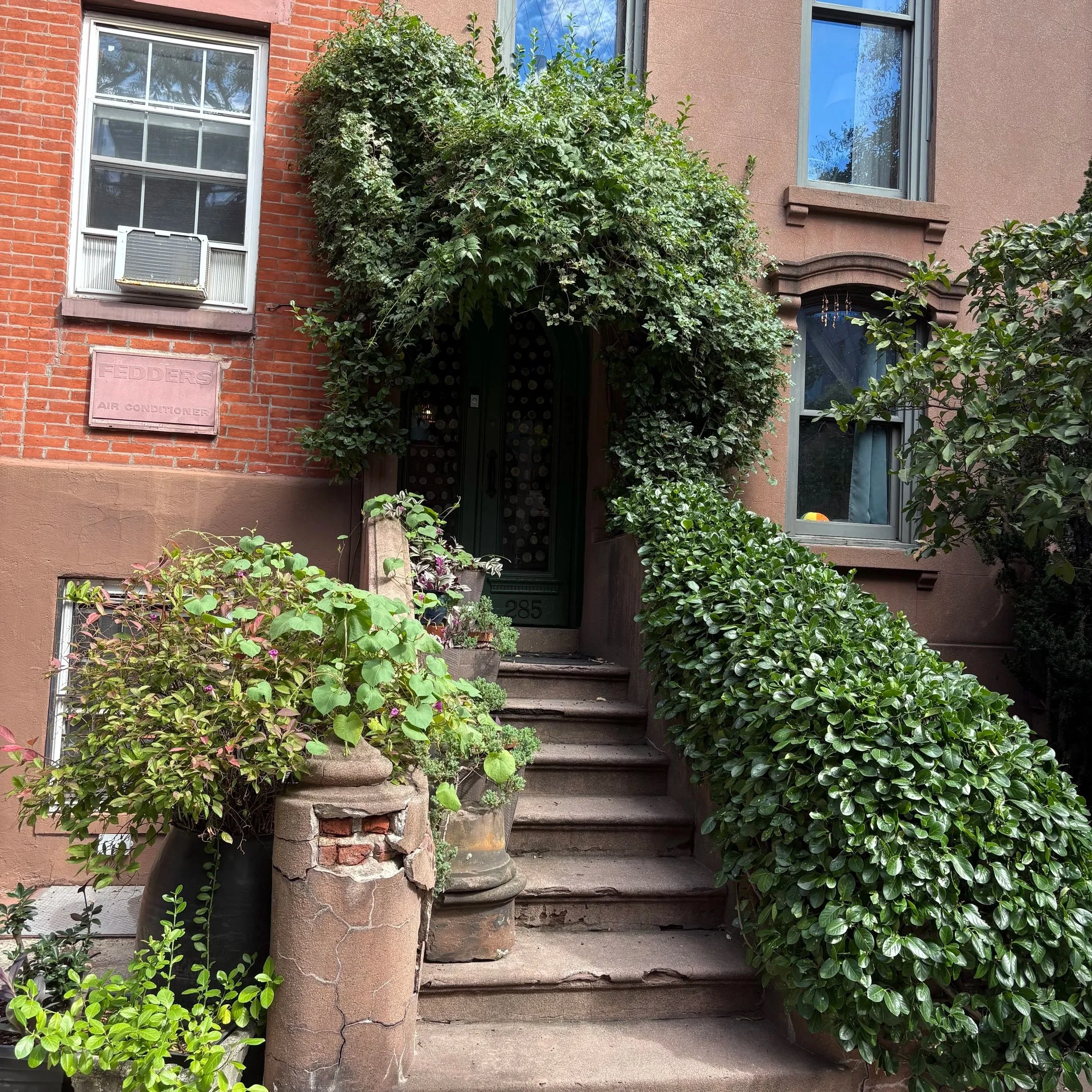
One of the defining characteristics of the neighborhood I live in, is the brownstones. Three or four-story residential buildings with a brown, sandstone exterior. The stoop, or the stairs that lead to the first floor, serves as a front porch of sorts. In the heat of summer, long-time residents bring out folding chairs and bask in the warm air. As the weather cools, stoop hangs continue, blankets and layers paired with a hot coffee or a glass of wine in the evening. These stoops serve not only as a means of entry to the building, but also as a place of gathering.
When I first moved to this neighborhood over 15 years ago, I didn’t think much of the construction of the brownstones. I assumed the uniform steps and window sills were manufactured in some factory, stored in some warehouse to one day be selected and shipped to a house for installation. It wasn’t until I saw the process of restoration play out that I truly understood the craft inherent within each of these buildings.
This process starts with tearing it all down, jackhammers employed to break apart the old facade, drilling down to the cement below. Then a rebuilding occurs. Sand and other materials are mixed outside in large basins. Then, usually, a team of two to three people applies the sandstone to the building. Levels and straight edges ensure uniform execution. This handcrafted process never ceases to amaze me. The level of skill and precision needed, inspiring.
And all this got me thinking about things, stuff, the objects that surround us. If I look around my room, every object my eye lands upon is here because of other humans. Whether it be the handmade ceramic incense burner I got in Mexico City or the lamp I purchased at Ikea nearly a dozen years ago, every object is the product of an idea, a plan, possibly a sketch and then the act of making. Even the manufactured items started as a prototype, required someone to assemble, to pack the pieces, to lift onto a shelf or deliver to a home.
Each required a spark, an insight, an idea. And also the support of other people to take that idea into reality. Remembering that each of these objects were created by humans, also feeds into this idea of connection.
It reminds me of the other morning, eating granola in the kitchen. I often make granola, a practice I learned from my dad nearly 30 years ago. As I was chewing pumpkin seeds and toasted oats, sweetened by honey and maple syrup, spiced with cinnamon, I thought about the plants. The sunflowers, the almond trees, the coconuts. How each of these ingredients had a whole life before this moment. Periods deep in the soil, the experience of rain, of sunshine. And then at some point, the feeling of a hand.
I then started thinking of the people who planted the seeds, tended to the plants and ultimately picked each of these ingredients. I thought of those who packed them up, shipped them off. I thought of the mail delivery person who delivered them to my home or the grocery worker who stocked packages on the shelf. In a single bite, I felt connected to all of those who contributed to this taste, this moment.
And that’s the thing, it can be easy to lose sight of all the ways we are connected these days. I’m not talking about the ways we can connect to each other, phone calls, text messages, emails, letters. I’m talking about remembering how all the simple things in our lives, brushing our teeth or pouring a glass of water, are made possible by other people. Often times by people we may never actually meet.
And so as you move through your days, I invite you to pause and consider the connected line of people that contributed to your moment. And if you do, I wonder what shifts you notice.
“It is a kind of love, is it not?
How the cup holds the tea,
How the chair stands sturdy and foursquare,
How the floor receives the bottoms of shoes
Or toes. How soles of feet know
Where they’re supposed to be.
I’ve been thinking about the patience
Of ordinary things, how clothes
Wait respectfully in closets
And soap dries quietly in the dish,
And towels drink the wet
From the skin of the back.
And the lovely repetition of stairs.
And what is more generous than a window?”